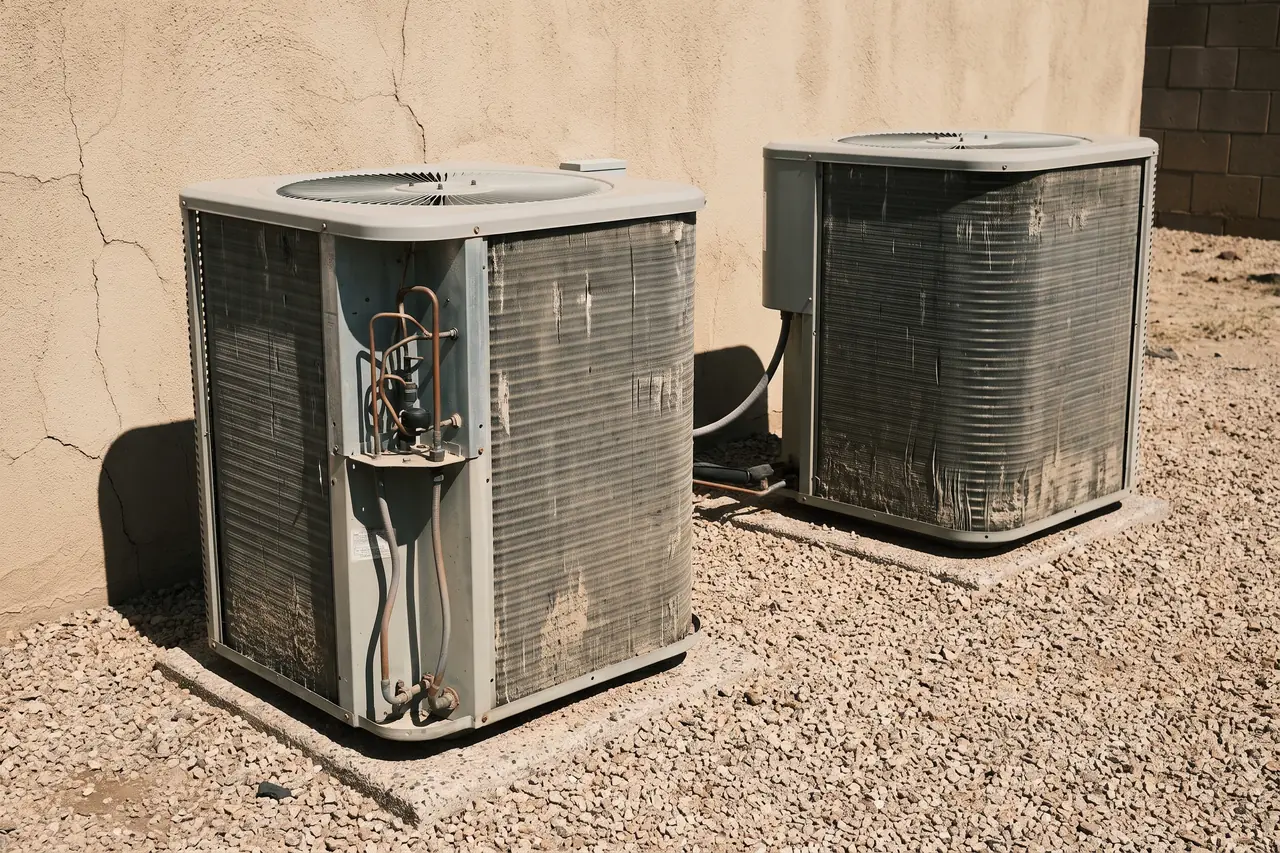
Every underwriting model carries a capital reserve, usually as a percentage of effective gross income. On a Phoenix rental, the largest single item that reserve has to fund is the air conditioning, and the standard service-life assumption imported from cooler markets is wrong.
A condenser running eight or nine months a year at high ambient temperature does not last twenty years. Twelve to sixteen is the realistic band, and the failure tends to arrive in July, when a replacement is neither cheap nor optional.
The arithmetic on one house
Take a 1,400-square-foot single-family rental with a four-ton system. A full condenser and coil replacement, permitted, runs roughly $8,500 at current pricing. Spread over a fourteen-year life that is about $607 a year of true reserve on that item alone.
A 5% capital reserve on an effective gross income of $21,000 is $1,050 a year — for the roof, the water heater, flooring, the exterior paint cycle and everything else as well. The HVAC line alone consumes 58% of it.
| Item | Replacement cost | Service life | Annual reserve |
|---|---|---|---|
| HVAC condenser & coil | $8,500 | 14 yrs | $607 |
| Shingle roof | $11,000 | 20 yrs | $550 |
| Water heater | $1,600 | 10 yrs | $160 |
| Interior flooring | $5,200 | 12 yrs | $433 |
| Exterior paint | $4,000 | 8 yrs | $500 |
Why it shows up as a yield difference
Two otherwise identical houses, one with a 2021 condenser and one with a 2009 condenser, are not the same asset. The second carries a near-term liability that no line in a seller’s statement mentions, because it has not happened yet.
On a $320,000 house, treating that liability honestly moves the estimated cap rate by roughly 0.2 to 0.3 points. It is not dramatic. It is the difference between the rows at the top of a screen and the rows in the middle.
What to actually check
- The data plate on the condenser, not the listing description. Manufacture date is encoded in the serial on every major brand.
- Whether the replacement was permitted. An unpermitted swap is a negotiating point and occasionally an insurance problem.
- Ductwork condition on anything pre-1980. A new condenser on failing ducts buys you efficiency you will not get.
- On small multifamily, the count. Four doors is four systems, and they tend to have been installed within a year or two of each other, which means they tend to fail within a year or two of each other.